Users
The Users interface allows administrators to manage user accounts, view user details, assign roles, and control access to the LinQ Explorer system.
Accessing the Users Interface
To access the Users management interface:
- Navigate to App Management from the main navigation
- Click on Users from the App Management menu
- The Users interface will display all registered users in the system
Users Interface Overview
The Users interface provides a comprehensive view of all users in the system. You can see user information, roles, organizations, and manage user accounts from this centralized location.

Header Section
The header section of the Users interface contains three main elements:
- Page Title: "RWD Users" displayed prominently at the top-left of the page
- Search Bar: Located in the top-right area, allows you to search for users by typing keywords in the "Search users..." field
- Add New User Button: A dark blue button with a user icon and "Add New User" text, positioned next to the search bar
Searching for Users

To search for specific users:
- Click in the "Search users..." input field in the header
- Type any part of the user's name, email, or other identifying information
- The table will automatically filter to show matching users as you type
- Clear the search field to view all users again
The search functionality filters the user table in real-time as you type. For example, typing "test" in the search field will display only users whose name, email, or other information contains "test". The filtered results are displayed immediately, making it easy to find specific users in large user lists.
Adding a New User
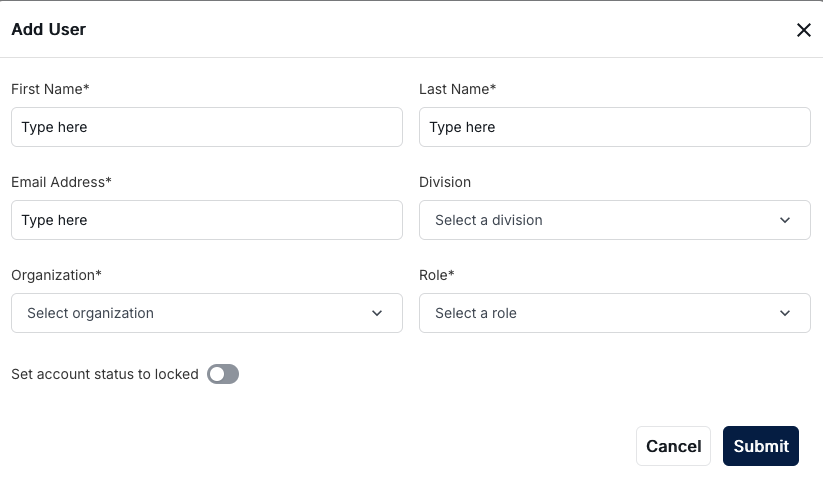
To add a new user to the system:
- Click the "Add New User" button in the header
- A dialog or form will appear prompting you to enter user details
- Fill in the required information:
- User name
- Email address
- Role assignment (User, Admin, etc.)
- Division assignment
- Other relevant user information
- Click "Save" or "Create" to add the user to the system
- The new user will appear in the users table
Add User Form Fields
The Add User modal contains the following fields:
- First Name*: Required field for the user's first name
- Last Name*: Required field for the user's last name
- Email Address*: Required field for the user's email address (used for login)
- Division: Optional dropdown to select the user's division
- Organization*: Required dropdown to select the organization the user belongs to
- Role*: Required dropdown to assign the user's role (User, Admin, etc.)
Fields marked with an asterisk (*) are required and must be filled in before the user can be created.
Account Status
Below the form fields, you'll find a toggle switch labeled "Set account status to locked":
- Unlocked (Default): When the toggle is off (gray), the account will be active and the user can log in immediately
- Locked: When the toggle is on, the account will be locked and the user cannot access the system until it's unlocked
Submitting the Form
At the bottom of the modal, you'll find two action buttons:
- Cancel: Closes the modal without saving any changes
- Submit: Creates the new user with the provided information and adds them to the system
Click "Submit" to create the user, or "Cancel" to close the dialog without creating a user.
User Data Table
The main content area displays a comprehensive table listing all users in the system. The table includes the following columns:
Table Columns
- Name: The full name of the user
- Email: The user's email address, which typically serves as their login identifier
- Role: The user's assigned role in the system (e.g., "User", "Admin")
- Division: The organizational division or department the user belongs to (e.g., "others", "citeline")
- Date Created: The date when the user account was first created, displayed in "DD Month, YYYY" format
- Created By: The email address of the administrator who created the user account (may show "-" if not available)
- Date Updated: The most recent date when the user account was modified (may show "-" if never updated)
- Updated By: The email address of the administrator who last updated the user account (may show "-" if not available)
- Lock Status: The current status of the user account, displayed as a button (typically "Active" shown in blue)
- Actions: Icons for editing and deleting the user record
Understanding User Status

The Lock Status column indicates whether a user account is active or locked:
- Active: The user account is active and the user can log in and access the system. This is displayed as a light blue pill-shaped button with white text "Active".
- Locked: The user account is locked and the user cannot access the system. This is displayed as a red pill-shaped button with white text "Locked".
The status is displayed as a colored button in the table, making it easy to identify the account state at a glance. The color coding (blue for Active, red for Locked) provides immediate visual feedback about each user's account status.
User Actions
Each user row in the table includes action buttons in the rightmost column:
Editing a User
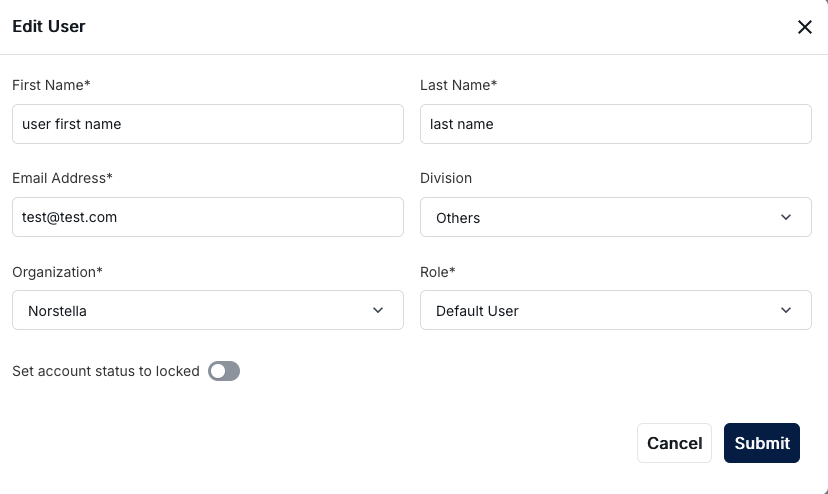
To edit an existing user's information:
- Locate the user in the table
- Click the pencil icon (edit icon) in the Actions column for that user
- An edit dialog or form will appear with the user's current information pre-filled
- Modify the fields you want to update:
- Name
- Role
- Division
- Lock Status
- Click "Save" to apply the changes
- The "Date Updated" and "Updated By" fields will automatically update to reflect your changes
Edit User Form Fields
The Edit User modal contains the same fields as the Add User form, but with the user's current information already populated:
- First Name*: Required field for the user's first name
- Last Name*: Required field for the user's last name
- Email Address*: Required field for the user's email address (used for login)
- Division: Dropdown to select or change the user's division (e.g., "Others")
- Organization*: Required dropdown to select or change the user's organization (e.g., "Norstella")
- Role*: Required dropdown to assign or modify the user's role (e.g., "Default User", "Admin")
Fields marked with an asterisk (*) are required. All fields will be pre-populated with the user's current information, allowing you to modify only what needs to be changed.
Account Status in Edit Mode
Below the form fields, you'll find a toggle switch labeled "Set account status to locked":
- Unlocked: When the toggle is off (gray), the account is active and the user can log in
- Locked: When the toggle is on, the account is locked and the user cannot access the system
You can toggle the account status to lock or unlock the user account as needed.
Submitting Changes
At the bottom of the modal, you'll find two action buttons:
- Cancel: Closes the modal without saving any changes
- Submit: Saves the updated user information and applies the changes to the system
Click "Submit" to save your changes, or "Cancel" to close the dialog without modifying the user information.
Deleting a User
To delete a user from the system:
- Locate the user in the table
- Click the trash can icon (delete icon) in the Actions column for that user
- A confirmation dialog will appear to prevent accidental deletions
- Confirm the deletion by clicking "Delete" or "Confirm" in the dialog
- The user will be removed from the system and will no longer appear in the table
Pagination Controls
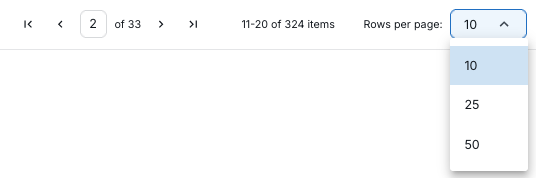
When there are many users in the system, the table uses pagination to display users in manageable pages. The pagination controls are located at the bottom of the table.
Pagination Features
- Page Indicator: Shows the current page number and total pages (e.g., "1 of 33")
- Item Count: Displays the range of items shown and total items (e.g., "1-10 of 324 items")
- Rows Per Page: A dropdown menu allowing you to select how many users to display per page (default is 10)
- Navigation Arrows: Four navigation buttons:
- First page (jump to the beginning)
- Previous page (go back one page)
- Next page (advance one page)
- Last page (jump to the end)
Using Pagination
To navigate through multiple pages of users:
- Use the arrow buttons to move between pages
- Click the first/last page buttons to jump to the beginning or end of the list
- Use the "Rows per page" dropdown to change how many users are displayed per page (10, 25, 50, 100, etc.)
- The page indicator shows your current position in the list
Key Features Summary
- Comprehensive User List: View all users in a sortable, searchable table format
- Quick Search: Instantly find users by typing in the search bar
- User Management: Add, edit, and delete user accounts with ease
- Role Assignment: Assign and modify user roles (User, Admin, etc.)
- Division Management: Associate users with organizational divisions
- Status Tracking: View and manage user account lock status
- Audit Trail: See who created and last updated each user account
- Efficient Navigation: Use pagination to browse through large user lists